
Finding the right rhymes separates memorable verses from forgettable bars. Whether you’re crafting your first sixteen or refining your hundredth track, mastering rhyme techniques gives you the toolkit to express complex ideas with precision, rhythm, and punch. The truth is, great rhyming goes far beyond matching end sounds. It’s about understanding multisyllabic patterns, knowing when to break conventional schemes for impact, and building a personal database of rhyme pockets that feel authentic to your voice.
This guide breaks down fifteen essential rhyme resources and techniques that working MCs rely on in 2026. You’ll explore foundational concepts like perfect and slant rhymes, dive into advanced methods including internal rhymes and polysyllabic stacking, and discover practical tools from online rhyme dictionaries to collaborative writing practices. Each technique comes with real-world application, so you can immediately strengthen your writing process. Hip-hop’s creative landscape continues to expand across cultures and communities, rewarding artists who combine technical skill with genuine perspective. The rhyme schemes that resonate aren’t just technically sound, they carry meaning, emotion, and the unique fingerprint of the MC behind the mic.
How We Curated This List
We curated this list by prioritizing rhyme techniques and approaches that deliver versatility across diverse hip-hop styles, from boom-bap to melodic trap to experimental underground flows. Each entry was chosen for its creative potential, cultural relevance, and ability to help rappers express authentic ideas rather than force awkward phrasing. These aren’t arbitrary rules handed down from on high, they’re tools drawn from both foundational practices that have anchored the genre for decades and the boundary-pushing innovation shaping 2026’s lyrical landscape.
Our focus centered on word families and methods that resonate across regional scenes, languages, and subgenres, honoring hip-hop’s global reach. We looked for techniques that reward both new writers building their foundations and seasoned MCs refining their craft, ensuring every entry offers practical value no matter where you are in your journey.
1. Perfect Rhymes: The Foundation

Perfect rhymes are where vowel and consonant sounds align exactly from the stressed syllable onward, think ‘fate’ and ‘great’, or ‘shine’ and ‘mine’. They deliver immediate clarity and impact, which is why they form the foundation every rapper builds on first. When you need a punchline to land hard or a hook that sticks in listeners’ heads after one play, perfect rhymes do the heavy lifting without ambiguity.
Across trap, boom-bap, and conscious rap alike, these rhymes anchor choruses and memorable quotables because they feel satisfying and complete. The ear recognizes the match instantly, reinforcing your message and making bars easier to recall. Mastering perfect rhymes means you control the sharpest tool in your kit, the one that guarantees your words hit exactly where you aim them, every time.
2. Slant Rhymes (Near Rhymes): Adding Nuance
Slant rhymes, also called near rhymes, imperfect rhymes, or oblique rhymes, pair words with similar but not identical sounds. Think ‘bridge’ and ‘rich’, ‘moon’ and ‘tone’, or ‘thoughts’ and ‘lost’. The vowels or consonants echo each other without locking into perfect alignment, creating a looser, more conversational feel.
This flexibility is gold for rappers who prioritize storytelling over rigid structure. When you’re deep in a narrative about your neighborhood, your struggles, or your triumphs, forcing a perfect rhyme can twist your meaning or land you on a word that sounds unnatural. Slant rhymes let you stay true to what you actually want to say. They preserve your voice, your cadence, and the emotional honesty of the bar without sacrificing rhythm.
MCs across every subgenre, from introspective conscious rap to gritty street storytelling, lean on slant rhymes to keep verses sounding human. They open up your vocabulary, reduce awkward phrasing, and give you room to explore ideas without the constraints of exact phonetic matches. Mastering slant rhymes means you control the language instead of letting the rhyme scheme control you.
3. Multisyllabic Rhymes: Showcasing Skill
Multisyllabic rhymes, where two or more syllables lock together across phrases, separate competent writers from technical wizards. Think “orange blossom” mirrored by “door hinge problem,” or the classic “education” / “the nation.” These compound rhymes require precision: every syllable must align in sound and stress, creating cascading patterns that hit the ear like rapid-fire percussion.
When done right, multis turn verses into lyrical obstacle courses that reward close listening. They showcase an MC’s command of rhythm and vocabulary, proving they can juggle phonetics without sacrificing meaning or flow. Listeners catch the complexity on first play, then discover new layers with each repeat. The technique thrives across subgenres, whether you’re stacking syllables in battle rap to assert dominance or weaving them through melodic hooks to add depth.
Start simple: match two-syllable pairs, then build to three or four as your ear develops. The goal isn’t cramming syllables for show; it’s creating intricate rhythmic textures that make your bars unforgettable and demand respect.
4. Internal Rhymes: Layering Your Bars
Internal rhymes turn a single bar into a micro-performance, stacking sound matches inside the line instead of just at the tail end. When you rhyme words mid-phrase with others in the same breath, like “I stay sharp, play my part, blaze the chart in the dark”, you’re layering rhythm on rhythm, giving the listener more to latch onto. It creates a cascading effect, where each internal echo propels the verse forward with extra snap and cohesion.
This technique adds density without clutter. A well-placed internal rhyme makes a bar feel complete, intentional, and alive with movement. It’s especially powerful in uptempo tracks where rapid-fire delivery demands constant engagement, or in storytelling verses where you want every syllable to carry weight. Listen to classic and contemporary MCs who weave internal rhymes throughout their verses, you’ll notice how those bars stick, how they feel fuller and more urgent. The trick is spacing them naturally so they enhance flow rather than trip it up. When done right, internal rhymes transform ordinary lines into memorable, quotable moments that reward close listening and replay.
5. Assonance: Vowel-Driven Flow
Assonance weaves vowel sounds together across words, creating an almost musical thread through your bars. When you rap “stay paid, way late, chasing fate,” those repeated long-a sounds bind the line into a smooth, cohesive unit that feels intentional rather than random. This technique lives between strict rhyming and free verse, giving you sonic consistency without the predictability of perfect end rhymes.
In melodic rap especially, assonance becomes your secret weapon for maintaining flow while shifting between singing and rapping. The vowel repetition carries melody naturally, letting you glide over beats without hammering obvious rhymes. Think of lines where the “ee” sound recurs, or “oh” vowels echo through a bar, softening hard consonants and creating wavelike momentum. It’s subtle craft that rewards careful listening.
Aggressive delivery can actually benefit from assonance too. Repeating short, sharp vowel sounds like “i” in “spit quick hits” adds percussive energy without losing the connective tissue that holds your verse together. The key is balancing it with your other techniques so the vowel pattern enhances rather than overshadows your message.
6. Consonance: Percussive Punch
Consonance lands like a drumbeat in your bars. It’s the repetition of consonant sounds, especially at the end of words, that gives your delivery a sharp, percussive edge. Think “blank and think” or “last blast.” The repeated hard consonants create a staccato rhythm that punches through a beat, forcing listeners to feel the weight of each word.
This technique works beautifully in battle rap and aggressive verses where you need your lines to hit with physical impact. When you stack consonant sounds, you’re essentially programming micro-accents into your flow, adding texture that makes your delivery sound intentional and controlled. Notice how consonance at line endings creates a satisfying snap, different from the melodic resolution of perfect rhymes.
You don’t need to match every sound perfectly. Even partial consonance, repeating just the final consonant cluster, adds that percussive quality. Try ending consecutive lines with words like “strength,” “bent,” and “meant.” The shared “nt” sound creates cohesion without feeling predictable, and the hard stop gives your voice a natural emphasis point that translates power.
7. Alliteration: Rhythmic Repetition
Alliteration stacks the same consonant sound at the start of successive words, creating a percussive, instantly recognizable phrase. Think “big boss business,” “money, mission, motivation,” or “paper planes and Patrón”, the repetition acts like a drum pattern for your vocals, making lines stick in the listener’s head long after the track ends. This technique shows up everywhere in hip-hop, from hook construction to signature ad-libs, because it delivers rhythm and memorability without requiring complex rhyme schemes.
Smart use of alliteration turns ordinary bars into quotables. It works especially well for branding yourself, your name, your crew, your signature phrase, because the sonic consistency makes it feel intentional and polished. You can layer alliteration with internal rhymes or multisyllabics for added density, or let it stand alone to emphasize a key moment. Just avoid overdoing it; too much repetition can sound forced or gimmicky. Deploy alliteration strategically where you want maximum impact and instant recall.
8. Rhyme Schemes (AABB, ABAB, ABCB): Structuring Verses
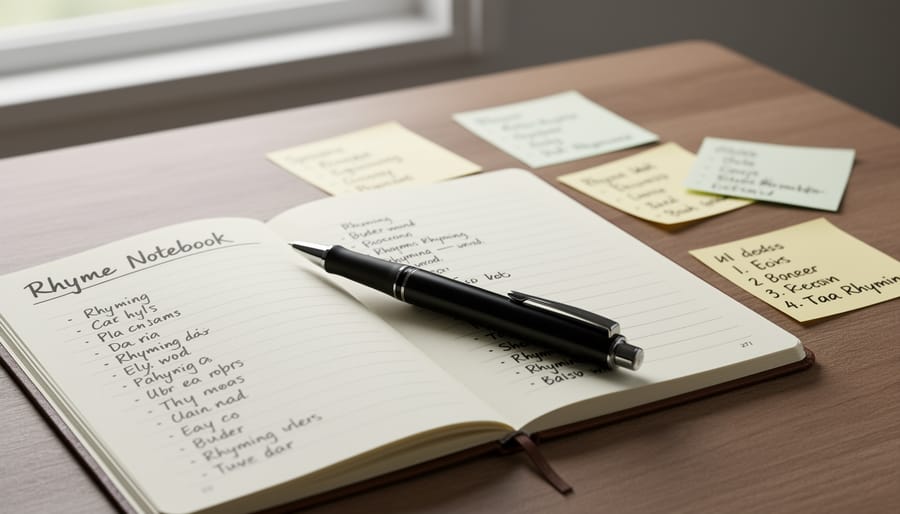
Rhyme schemes provide the structural blueprint for how your bars connect across multiple lines. The most basic is AABB (couplet rhyme), where consecutive lines rhyme, think “I step to the mic with intent / My words hit hard, that’s money well spent.” This pattern delivers immediate satisfaction and works well for straightforward punchlines. ABAB (alternating rhyme) spaces rhymes across every other line, creating breathing room and a more conversational feel that suits storytelling: line one rhymes with line three, line two with line four. ABCB uses only one rhyme pair per four bars, letting the first and third lines stand free while the second and fourth connect, a looser structure that prioritizes natural speech rhythm.
Understanding these foundational patterns gives you control over pacing and listener expectation:
- AABB creates rapid-fire energy with back-to-back rhymes
- ABAB builds anticipation by delaying the rhyme payoff
- ABCB allows flexibility, blending rhymed and unrhymed lines for varied texture
- AAAA (monorhyme) locks all four bars to one sound for hypnotic repetition
The real power comes from switching schemes mid-verse or layering them with internal rhymes. Drop from AABB into ABAB to shift momentum, or abandon the pattern entirely for a bar to create tension before snapping back. Mastery means using structure intentionally, knowing when consistency serves your flow and when disruption makes the listener lean in.
9. Rhyme Dictionaries and Digital Tools
Rhyme dictionaries have evolved far beyond dusty reference books. In 2026, rappers have access to powerful digital tools that surface rhymes in seconds, from classic resources like RhymeZone and B-Rhymes to specialized apps like Rapchat and Genius that integrate rhyme suggestions directly into recording workflows. These platforms excel at revealing unexpected connections: type in “ambition” and discover not just “position” but multisyllabic matches like “ammunition” or slant options you’d never considered. The best tools also highlight regional slang variations and cultural context, supporting the diverse voices central to the Black arts traditions that birthed hip-hop.
Yet technology serves creativity, not the other way around. Use these resources to expand your vocabulary and break writer’s block, but don’t let algorithms dictate your voice. The most memorable bars come from human intuition, the unique associations only you can make. Think of rhyme dictionaries as sparring partners that challenge you to dig deeper, not crutches that write your verses for you. They open doors; you still choose which ones to walk through.
10. Wordplay and Double Entendres
Wordplay transforms basic rhymes into quotable art. The difference between saying “I’m getting paid” and “I’m getting bread while they toast to my success” is layers, one states a fact, the other invites the listener to unpack the metaphor. Double entendres work on two levels simultaneously, creating meaning that shifts depending on context or perspective.
Strong wordplay rewards close attention. When an MC references their hustle in terms that also nod to their hometown’s landmarks, cultural touchstones, or even specific communities like LGBT neighborhoods, they’re embedding identity and insider knowledge into the verse. The surface meaning satisfies casual listeners while the deeper layer connects with those who recognize the references.
Crafting effective doubles requires balancing clarity with subtlety. Too obvious and the wordplay feels forced; too obscure and it flies over heads entirely. The sweet spot is when both meanings land cleanly but one takes a beat longer to register. Practice by listing words with multiple definitions, then building bars where both senses apply to your narrative. Read your favorites’ lyrics closely to study how they layer meaning without disrupting flow or sacrificing sonic appeal.
11. Regional Slang and Cultural References
Regional slang isn’t just flavour, it’s the DNA of authentic hip-hop expression. Drawing rhymes from your community’s dialect, local references, and cultural shorthand creates instant connection with listeners who share that experience while giving outsiders a window into your world. Toronto rappers weave Patois and GTA slang into bars that resonate locally and intrigue globally. Atlanta’s vernacular shaped an entire sonic era. These aren’t arbitrary word choices; they’re cultural markers that signal belonging and lived reality.
Using region-specific language honours hip-hop’s foundational principle: telling your truth in your voice. A Bay Area MC threading hyphy slang through their rhymes or a Montreal artist code-switching between French and English creates lyrical texture that generic vocabulary can’t match. The key is authenticity over appropriation. Don’t force slang from a culture you haven’t lived just because it sounds cool. Your genuine references, the ones rooted in your neighborhood, your family’s sayings, your community’s inside jokes, carry weight that listeners feel immediately.
This approach also preserves hip-hop’s diversity. When rappers across geographies use their distinct vocabularies, the genre stays vibrant, multifaceted, and representative of different Black, Indigenous, immigrant, and working-class experiences worldwide.
12. Freestyling for Rhyme Discovery
Freestyling transforms rhyme discovery from a desk-bound exercise into a live, instinctive practice that trains your brain to make connections on the fly. When you improvise without a safety net, you’re forced to reach for words, sounds, and patterns you might never consider during careful writing sessions. That spontaneous pressure often surfaces unexpected rhyme pockets, slant connections, internal placements, and vowel runs that feel natural in the moment but would seem too risky on paper.
Regular freestyle practice builds what veteran MCs call a “mental rhyme database.” Each session strengthens your ability to recall word families, flip syllables mid-bar, and navigate around dead ends without losing momentum. You develop muscle memory for phonetic patterns, which makes your written work sharper and more adventurous. Freestyling also reveals your authentic voice, the cadences, phrases, and rhythmic choices that emerge when you’re not overthinking.
Approach freestyling as creative exploration rather than performance pressure. Record yourself, practice alone or with trusted collaborators, and revisit recordings to mine gems worth developing. The rhymes you stumble into during improvisation often carry the energy and naturalness that polished writing sometimes lacks.
13. Rhyme Notebooks and Voice Memos
The best rhyme often strikes when you’re nowhere near a studio, on the bus, mid-conversation, or half-asleep. That’s why serious rappers carry capture systems: a pocket notebook, a notes app, or voice memos ready to roll. The method matters less than the habit. When a phrase hits, record it immediately. Your brain won’t hold onto that exact wording or cadence for hours, and what feels unforgettable at 2 a.m. vanishes by breakfast.
Over time, these fragments accumulate into a personalized rhyme bank, a living archive of your vocabulary, perspective, and rhythmic instincts. Flip through old entries before a session and you’ll find half-finished bars that suddenly fit a new beat, or a single line that sparks an entire verse. This practice also trains your ear: the more you document your creative impulses, the sharper you become at recognizing patterns and connections in real time. It’s low-tech, unglamorous work, but it builds the raw material that separates a full catalog from a handful of songs.
14. Collaboration and Cypher Culture
Stepping into a cypher or teaming up with another MC reveals rhyme possibilities you might never discover alone. When you’re exchanging bars in real time, you hear how someone flips a familiar word with fresh cadence, stretches a slant rhyme you thought wouldn’t work, or layers internal patterns you hadn’t considered. That immediate creative feedback loop, rooted in respect and collective energy, sharpens your instincts faster than any solo practice session.
Collaboration thrives on diversity. Working with artists from different backgrounds, whether they’re genderqueer voices rewriting hip-hop narratives or initiatives like a queer feminist press amplifying marginalized stories, expands your vocabulary and worldview. These exchanges teach you to craft rhymes that reflect lived experience rather than recycled formulas. The goal is genuine connection, avoid fake engagement and chase authentic community instead. When you contribute to a cypher or co-write a verse, you’re not just borrowing techniques; you’re building a shared language that pushes everyone’s artistry forward.
15. Breaking the Rules: When Not to Rhyme
Sometimes the most powerful move is choosing not to rhyme at all. Breaking rhyme patterns creates breathing room, shifts listener attention, and lets emotion or narrative land without the predictability of matched sounds. When Kendrick Lamar switches mid-verse from intricate rhyme schemes into spoken conversational flow, he forces you to lean in and listen differently, the content becomes the focus, not the technique. This disruption can heighten tension before a punchline, underscore a vulnerable confession, or signal a tonal shift that pure rhyme would soften.
Rappers rooted in storytelling traditions often drop rhyme structure entirely for stretches, adopting prose-like delivery that mimics natural speech. This works especially well in narrative arcs where you’re painting a scene or exploring complex ideas that resist neat couplets. The absence of rhyme doesn’t mean the absence of rhythm, cadence, pauses, and emphasis still carry the bars forward.
True mastery means recognizing when rhyme serves the moment and when it constrains it. If a line hits harder without a rhyme partner, leave it naked. Audiences respect authenticity over formula, and sometimes the most memorable bars are the ones that refuse to play by the rules you’ve spent the whole verse establishing.
Key Takeaways
The tools and techniques covered in this guide aren’t rules to follow rigidly but resources to draw from as your creativity demands. Every rhyme choice you make shapes how your message lands, how your flow rides the beat, and how deeply your bars resonate. Some verses call for the precision of perfect rhymes; others need the organic feel of slant rhymes or the percussive punch of consonance. The strongest rappers know when to deploy multisyllabic fireworks and when to strip it back to raw storytelling without forced patterns.
Growth comes from balancing study with spontaneity. Use rhyme dictionaries and digital tools to expand your vocabulary, but trust your instincts when a phrase feels right even if it breaks conventional structure. Participate in cyphers, keep notebooks, freestyle regularly, and stay open to influence from artists across regions and eras. Your voice emerges not from copying one technique but from blending them into something unmistakably yours, bars that reflect your experiences, your community, and your vision for where hip-hop goes next.
Frequently Asked Questions
What’s the best rhyme type for beginners?
Perfect rhymes offer the clearest foundation because they’re easy to hear and remember, helping new rappers develop timing and confidence. Once you’re comfortable, layer in slant rhymes to keep your vocabulary natural and avoid forced phrasing.
Do all great rappers use multisyllabic rhymes?
No. Some legendary MCs built careers on simple, impactful perfect rhymes that served their storytelling and delivery. Multisyllabics showcase technical skill, but clarity, emotion, and authenticity matter more than complexity alone.
How do I avoid forcing rhymes?
Write your message first, then find rhymes that support it, never twist your meaning just to hit a sound. If a rhyme feels awkward, try a slant rhyme, rewrite the line, or switch your scheme entirely rather than sacrificing what you’re trying to say.
Can I mix different rhyme techniques in one verse?
Absolutely. Combining perfect rhymes, internals, assonance, and other techniques in a single verse creates depth and keeps listeners engaged. The key is making the mix feel intentional, not random.
These questions reflect real concerns emerging and established rappers share when refining their craft. Experiment freely, trust your instincts, and remember that rules exist to guide you, not limit your voice.
Mastering rhyme is a journey, not a finish line. This toolkit, from perfect rhymes to freestyling, slant rhymes to breaking the rules, gives you the range to express exactly what you want, however you want. The best rappers don’t just follow formulas; they blend techniques, trust their instincts, and let the story guide the sound. Experiment freely. Mix multisyllabics with slant rhymes. Break a pattern to make a point. Write from your truth, your community, your corner of the culture.
Hip-hop thrives because it welcomes every voice, every background, every style. Your rhymes are part of that legacy. Keep pushing your pen, stay curious, and remember: the words you choose have power. They connect, challenge, celebrate, and inspire. Whether you’re crafting your first sixteen or your thousandth, the craft rewards those who show up with intention and love for the art. Now go create something unforgettable.
You may also like
-
The Media Bias Chart Everyone’s Talking About (And Why It Matters to You)
-
7 pH-Neutral Car Shampoo Tips Every Canadian Driver Should Know
-
How to Read Canada’s Media Bias Chart: Where Your News Sources Actually Fall
-
How to Sell an Inherited Property in Canada: Timeline and Steps
-
Why Canadian LGBTQ+ Communities Are Reshaping Vaping Culture